
The primary objective of investing is profit generation, prompting most investors to inquire about their return on investment. We provide some insights into return metrics, their benefits, and limitations.
Investment Returns
In its simplest form, investing involves committing a dollar amount, patiently awaiting its growth, and eventually receiving a larger sum. The metrics below illustrate this process:

The example above demonstrates how our Pick Me Up strategy transformed a hypothetical $1,000 investment in January 2007 into over $4,500 by April 2020. To put this number in context, we employ benchmarks, and the SPDR’s S&P500 ETF (SPY) serves as a good reference. It reveals that Turingtrader's Pick Me Up outperformed the benchmark.
While absolute numbers are intuitive, comparing them is not straightforward. To address this issue, we calculate the Compound Annual Growth Rate (CAGR).

CAGR represents the investment's growth as an annual percentage. In this case, TuringTrader’s Pick Me Up achieved over 12% per year during the simulation period. This figure assumes that all gains remain invested, they are continuously compounded.
Equity Chart
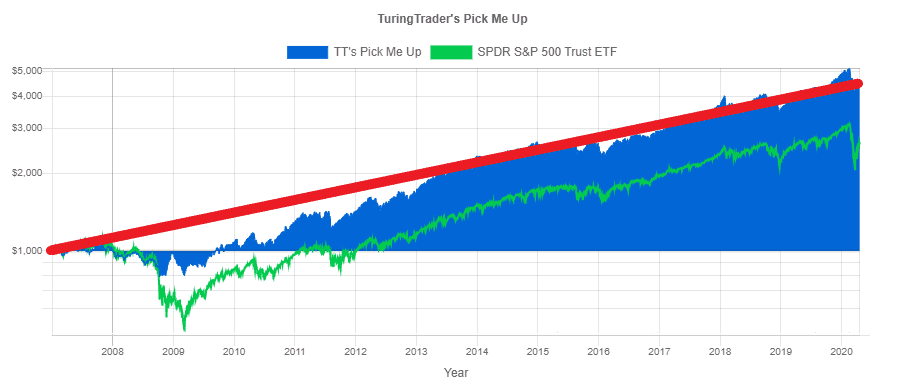
We can find the same information on the Equity Chart. Horizontally, we see the time axis: starting in January 2007 and ending in April 2020. Then, vertically, we have the dollar value of our investment: starting at $1,000 and ending at $4,500.
Please note that we scale the vertical axis logarithmically. This type of scaling has several advantages over linear scaling:
- Equal growth factors, e.g., a doubling in value, result in the same vertical distance: the distance from $1,000 to $2,000 is the same as the distance from $2,000 to $4,000.
- The resulting chart shows a straight line if an investment grows at a constant rate.
- If two investments grow at the same rate, their equity curves are parallel.
The CAGR cannot be found directly on the chart. However, we find it represented by the slope of the equity curve: the steeper the slope, the higher the growth rate.
Bar Chart
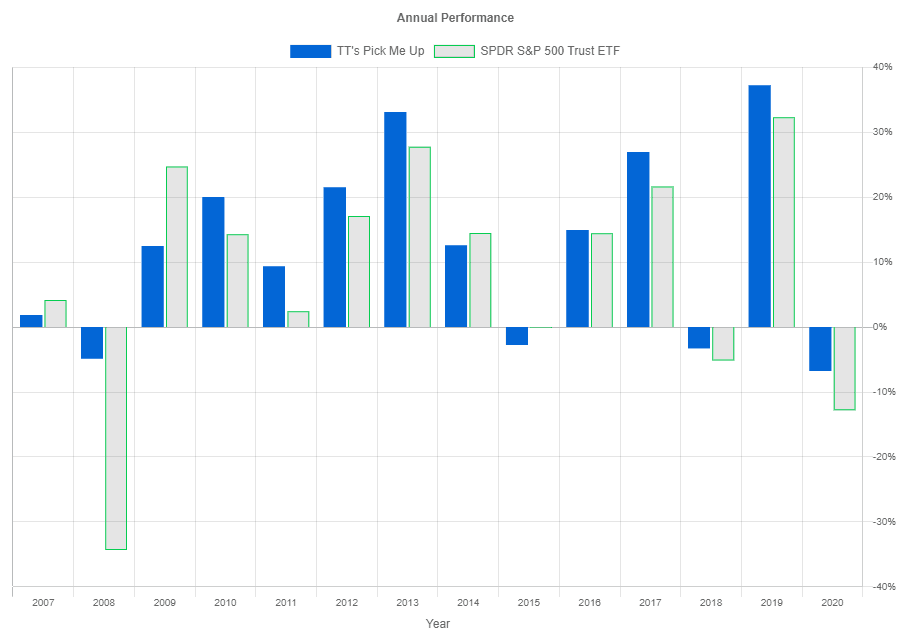
Most investments fail to provide steady returns with a consistent growth rate. Instead, their growth rate fluctuates, making it difficult to read from the chart. Here, a Bar Chart is beneficial showing the annual returns. Horizontally, we see the calendar years and, vertically the growth rate for each calendar year.
Although this is a common and useful representation, it has inherent limitations. For once, it fails to illustrate details between the beginning and end of the year, potentially masking a turbulent path. Additionally, any gains or losses close to the end of the year induce some misleading fluctuations in the chart.
Rolling Returns
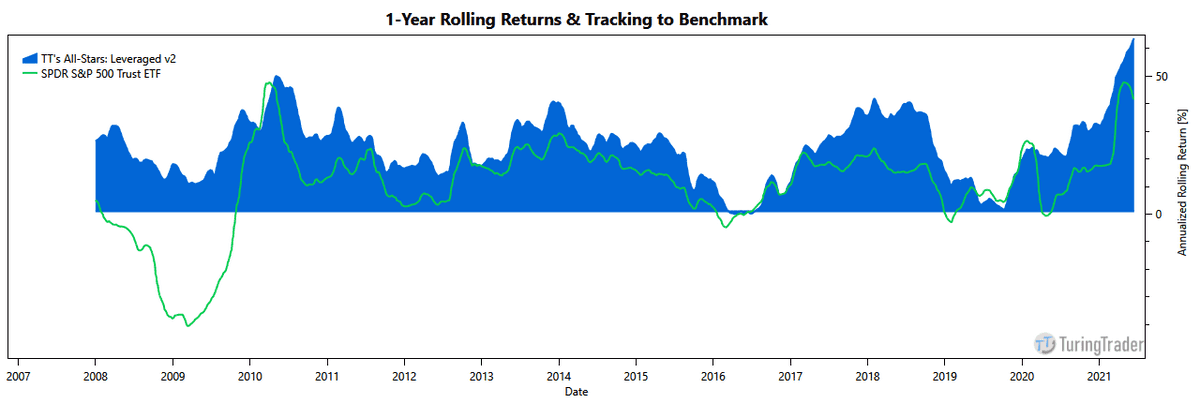
We can address this issue by calculating the rolling 12-month returns. Instead of discrete bars, we now have a smooth line representing our returns. This view makes it easy to spot periods of outsized returns or underperformance. Also, the raggedness of the curve provides an intuitive impression of the portfolio's volatility.
However, challenges arise with shorter lookback periods (e.g., 3 months), as these charts tend to become noisy and difficult to interpret. Consequently, rolling return charts are most effective for periods of 1 year or longer. Also, while positive returns are easily understood, these charts lack information on total losses and recovery durations when returns turn negative, posing limitations in providing a comprehensive view of these crucial aspects.
Tracking Chart
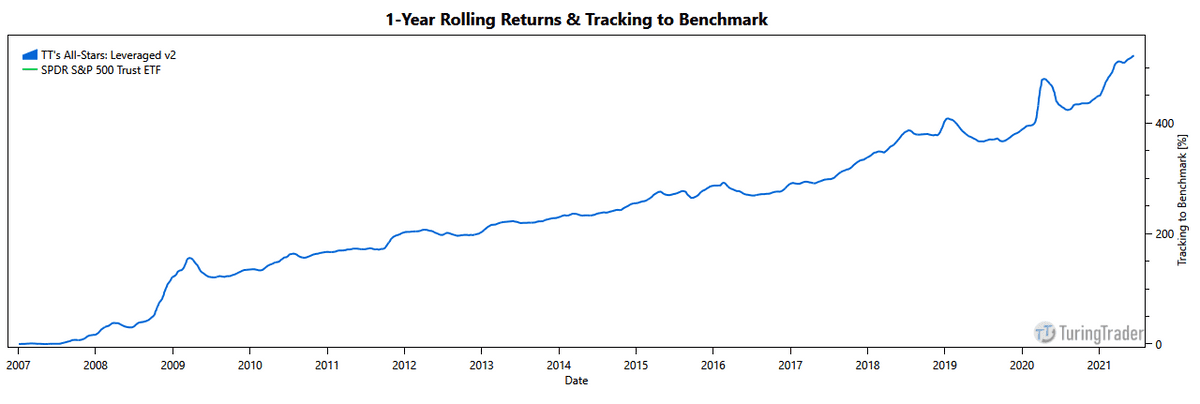
As comparing portfolios remains difficult, tracking charts are helpful tools. We create it by dividing the equity curve of our portfolio by the benchmark curve. As a result, we can see how much better or worse than the benchmark a portfolio performed. If they perform the same, the line runs horizontally. If the portfolio beats the benchmark, the line slopes upwards.
Nonetheless, tracking charts come with limitations too. They exclusively display relative performance and offer no insights into absolute performance. Instances where both the investment and its benchmark decline simultaneously are indiscernible. This limitation is common, as benchmarks are typically selected for their similarities to the investment's characteristics.
Conclusion
While these return metrics offer some insights into an investment's performance, they all have significant limitations. They often conceal or understate associated risks, and therefore a combination of these measures with risk metrics is necessary.
See Also
- Apply these metrics in our portfolio comparison chart.
- What to expect from TuringTrader
- What is Tactical Asset Allocation
- How we backtest