
Losing money is a painful experience. Therefore, effectively managing investment risk is essential, and our charts and metrics help us consider various measures such as volatility, maximum drawdown, Ulcer Index, and Beta. These unique insights into different aspects of risk get us a step closer to helping us make holistic investment decisions.
Investment Risks
Investment returns are inherently variable and subject to fluctuations over time. In this context, a crucial measure is the Standard Deviation of Returns or volatility.

This figure serves as a gauge for estimating the probable range of investment returns. For instance, our Pick Me Up strategy has a Compound Annual Growth Rate of approximately 12%, with a corresponding Standard Deviation of Returns approaching 16%. From a statistical perspective, there is a 68% probability that Pick Me Up will yield annual returns within the range of -4% (12% minus 16%) and +28% (12% plus 16%).
Bar Chart
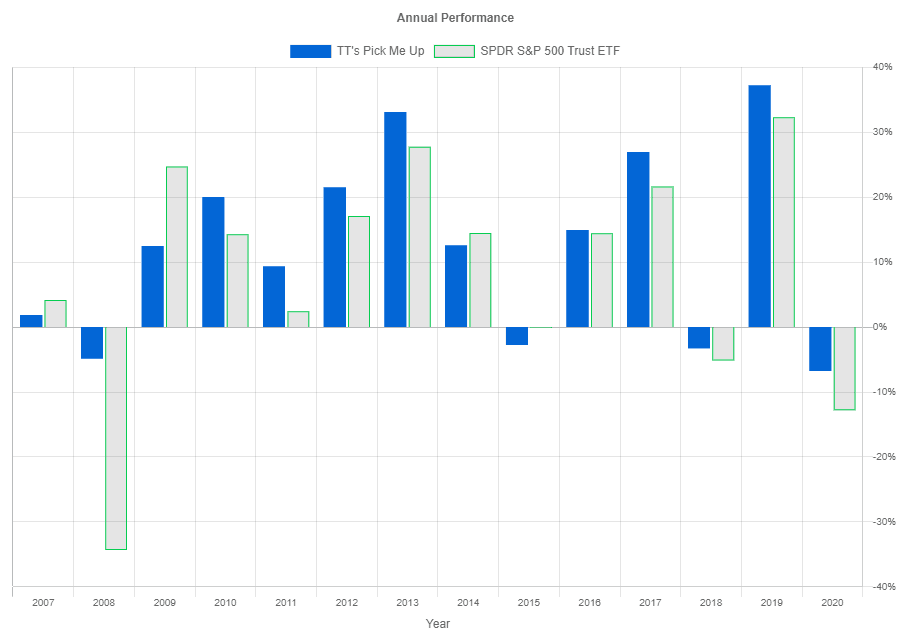
The accompanying Bar Chart visually reinforces that the Pick Me Up returns consistently align with these boundaries, while, of course, there are no guarantees.
It's noteworthy that the Standard Deviation of Returns surpasses the Compound Annual Growth Rate for many strategies. This implies that volatility can overshadow the upward trend, presenting a substantial risk of financial loss within a given 1-year period.
Equity Chart
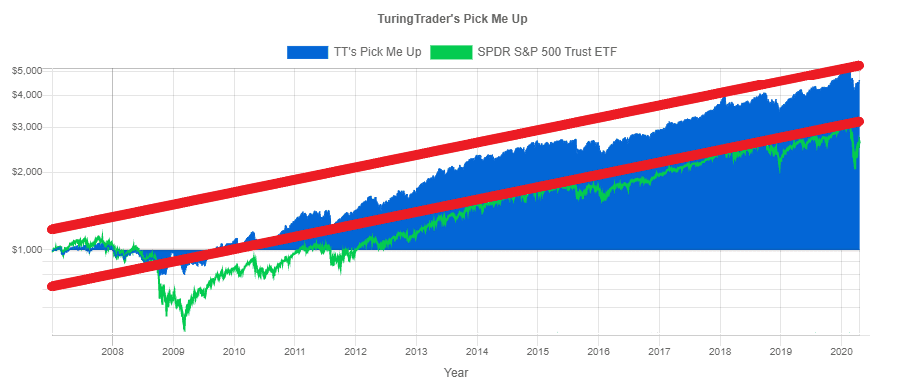
This measure is also visible on our Equity Chart. If CAGR is the slope, then the Standard Deviation of Returns represents the width of a corridor within which the equity curve ranges most of the time. While these metrics hold mathematical significance, many investors view investments differently: the expectation is for continual growth, and any reversal from this upward trajectory is perceived as a loss.
Underwater Chart
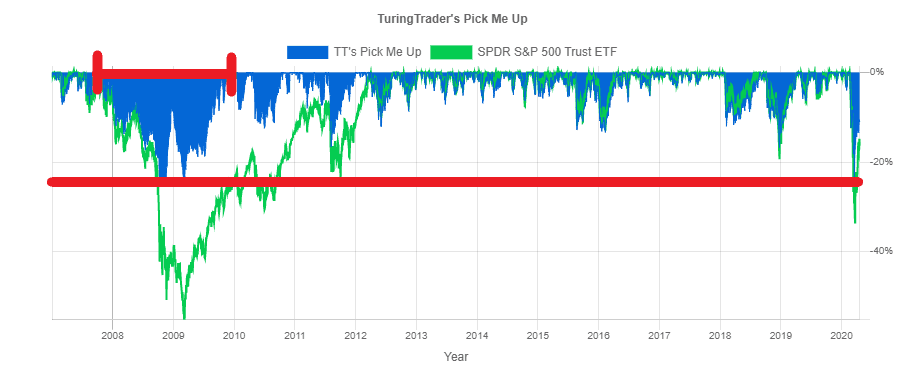
Underwater Charts reflect this view: they chart the percentage lost since a previous all-time high over time, the so-called drawdown. From the chart above, we learn that our Pick Me Up portfolio suffered its worst loss in late 2008, about 25% from its previous high. Further, we can see that the longest drawdown started in October 2007 and lasted until January 2010.
Our metrics show this information as follows:

In addition to the Maximum Drawdown, we also measure the Maximum Flat Days. This number is the longest time it took from one peak to making a new all-time high. With 805 days, this is more than two years. And even though that is a long time, this is still less than half of the benchmark.
We calculate the Maximum Drawdown at the end of each day. This leads to worse results than calculating drawdowns only at the end of the month.
Ulcer Index
Another way to quantify risk is the Ulcer Index. This index is the Root Mean Square of daily drawdowns.

Because the index uses squared drawdowns, it applies larger weights to more profound losses. Therefore, we can interpret the Ulcer Index as a representative drawdown, which our investment will reach frequently.
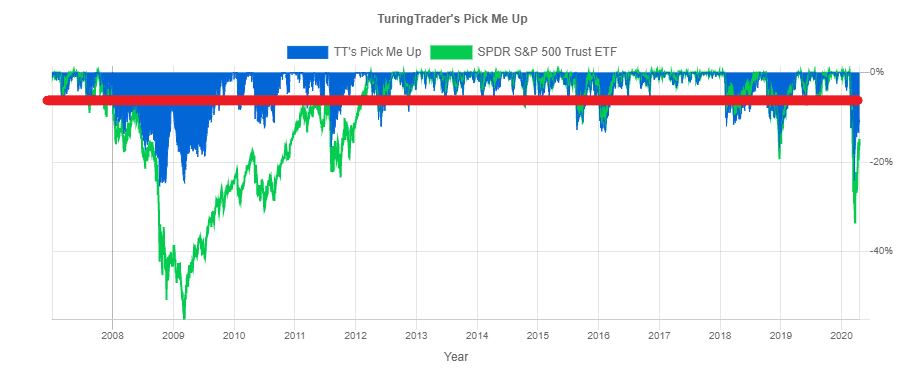
The chart above shows the Ulcer Index for TT's Pick Me Up strategy. Again, we see that the portfolio regularly reaches or exceeds this drawdown level.
Risk-Adjusted Returns
In our regular job, we get paid for performing our duty. Similarly, as investors, we get paid for taking on risk, the so-called risk premium. By dividing a return measure by a risk measure, we calculate Risk-Adjusted Returns. In a nutshell, these measures express how well we get paid for taking on risks.
The prima ry measure for assessing risk-adjusted returns is the Sharpe Ratio, which essentially divides the Compound Annual Growth Rate (CAGR) by the Standard Deviation of Returns. An additional nuance involves subtracting the Risk-Free Rate of Return from the profits before performing this calculation. This adjustment aligns to measure the assumption of risk, and receiving risk-free interest is not that. The risk-free rate was close to zero for a few years due to low interest rates until the rates rose again in 2022, but this has not been the case in prior decades.
The Sharpe Ratio has various calculation methods, complicating comparisons. At TuringTrader.com, we opt for using monthly returns and annualizing the results, with the Secondary Market Rate for the 3-month Treasury Bill serving as the risk-free rate.
Another crucial metric for gauging risk-adjusted returns is the Ulcer Performance Index or Martin Ratio, obtained by dividing the CAGR by the Ulcer Index. In our example, the Sharpe Ratio indicates that TT’s Pick Me Up portfolio yields over twice the return per unit of risk compared to a direct investment in the S&P 500. On the other hand, according to the Ulcer Performance Index, the Pick Me Up strategy achieves nearly four times the risk-adjusted return of the S&P 500. When comparing portfolios, it is good practice to watch for both measures.
However, while the Sharpe Ratio and Martin Ratio (higher values indicate higher quality investment) serve as valuable metrics for assessing the quality of investments, investors should not solely base their decisions on these metrics. They often underestimate tail risks, and volatility is not representative of investment risk.
Investors often believe that to achieve high returns, they have to take on high levels of risk. Risk-adjusted returns challenge this notion. Instead, investments with similar risk profiles can lead to significantly different profits, and Tactical Asset Allocation augments this effect.
Beta
Mathematically speaking, Beta is a measure of correlation. It is part of the Capital Asset Pricing Model and describes how much an investment moves in tandem with the market. Beta may seem desirable in bullish markets, as stocks with a Beta larger than one will provide amplified growth. However, in market downturns, we would prefer a low beta to reduce our losses. As markets are unpredictable, and in the context of portfolios, Beta is typically seen as a risk factor, though.
 This makes sense, as a well-rounded portfolio should appreciate value throughout all economic seasons and independently from a single asset class movement. On our site, we always measure Beta against the S&P 500, as stocks are the driver of growth in most portfolios and the most significant contributor to portfolio risk.
Conclusion
Understanding and managing investment risk is a nuanced process involving various measures, each with strengths and limitations.
Volatility, a widely-used measure, serves as the basis for many mathematical methods but poses challenges due to its non-directional nature and unintuitive explanation, often underestimating tail risks. Maximum drawdown offers an intuitive interpretation of downside risk, although its reliability diminishes when comparing different assets. The Ulcer Index has a less versatile application, though, but is effective in measuring downside risk and has an unintuitive interpretation. Beta, indicating market dependency, is valuable for determining market risk but is not strictly a risk measure. Drawdown Charts with shallower graphs intuitively represent lower risk but may underrepresent actual risk levels.
In evaluating investment quality, metrics like the Sharpe Ratio and Martin Ratios prove valuable, offering ways to compare investments objectively. However, we should not solely rely on these risk-adjusted metrics, as meeting minimum returns and the inability of retail investors to leverage up to institutional levels must be considered. Combining risk-adjusted metrics with return measures offers a more comprehensive understanding of an investment's nature and guides holistic financial decisions.
To complete the assessment of an investment, continue with our ex-ante measures which are tools to estimate possible future scenarios.
Apply these metrics in our portfolio comparison chart.