
The Ex-Ante range is a potent tool for identifying suitable investments and risk levels, emphasizing the importance of pessimistic scenarios over average returns. Time plays a pivotal role in influencing investment outcomes and revealing surprises for investors who might underestimate its impact.
Ex-Ante, signifying "before the event," involves predicting future investment outcomes, employing Monte Carlo Simulations in this context. These simulations generate thousands of hypothetical investment scenarios based on the historical distribution of returns. Percentiles (e.g., 5th and 95th) are then used to establish a range of likely outcomes, assisting in risk assessment under various conditions.
Monte-Carlo Simulations
Simulations of our strategies with historical data, so-called Backtests, are useful methods to analyze how the portfolios performed under past market conditions. However, even though markets go through cycles, history does not repeat itself exactly. Monte-Carlo Simulations address this issue by analyzing the range of possible outcomes based on given confidence intervals.
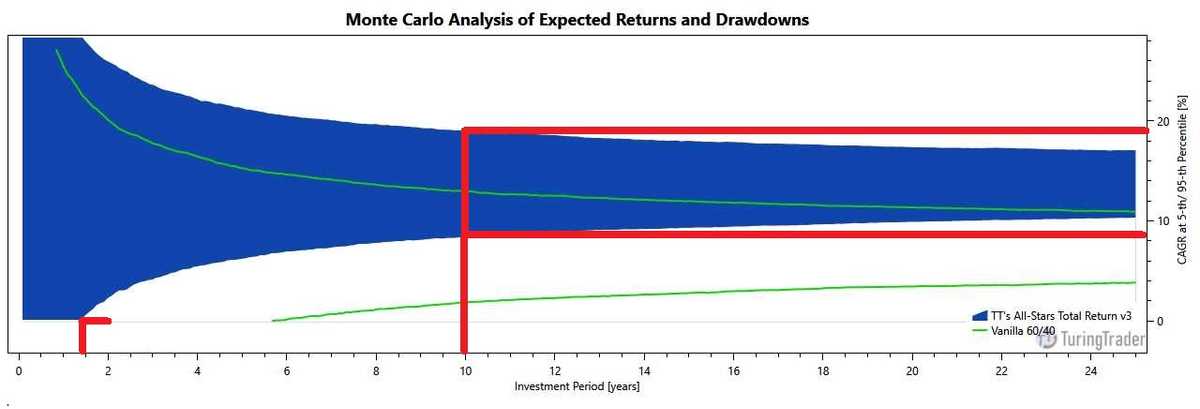
To evaluate a strategy's likely range of returns, we first calculate the distribution of monthly returns. Then, we run several thousand trials to create a set of equity curves, each representing an alternate reality based on the given distribution of returns. Next, we calculate an envelope of two equity curves, one representing the 5th percentile and the other the 95th percentile. Finally, we plot how the CAGR changes over time.
To read this chart, start on the horizontal axis, at the point representing your investment period. Next, read the upper and lower values for the CAGR on the vertical axis. The example above shows how, with a probability of 90%, All-Stars' Total Return CAGR will fall between 8.5% and 19% after ten years. Also, the chart shows how, with a probability of 95%, the portfolio's return will be positive after about 1.5 years. In comparison, an investment in a 60/40 portfolio will fall between 2% and 13% in the same period.
These charts are valuable tools for determining suitability for an investor's personal circumstances, as they show the relationship between portfolio volatility and the investment horizon. To learn more about using these charts for financial planning, read our background article explaining our portfolio wizard.
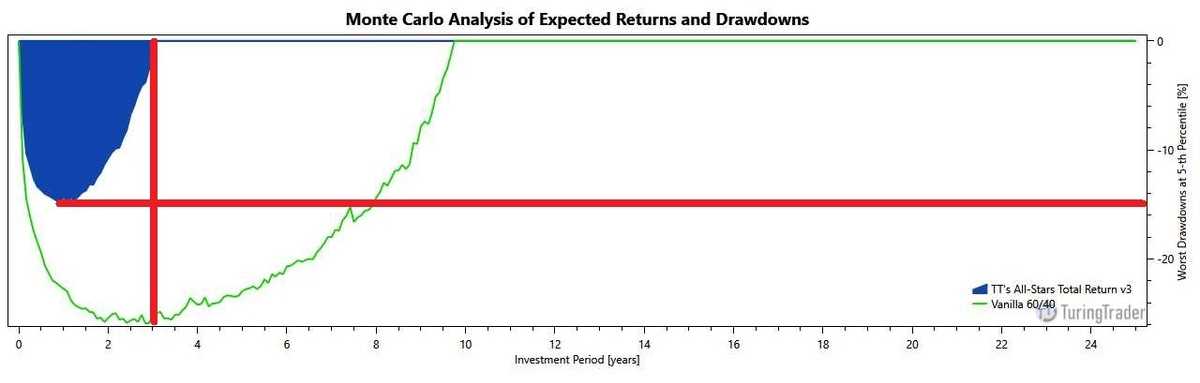
For Drawdowns, the charts show how deep drawdowns might look like. Again, the process starts with creating a swarm of equity curves. However, this time, we analyze all drawdowns, regardless of how short-lived or insignificant they might be. Next, of these drawdowns, we select those 5% that go the deepest. Finally, we create an underwater curve at the 5th percentile of these deepest drawdowns. This chart represents the depth and duration we expect to see under prolonged bearish conditions, e.g., during a recession.
To read the chart, pick a point on the underwater curve and extend it to the horizontal or vertical axis. The example above shows that All-Stars Total Return might lose about 15% during a recession and might take about three years to recover from those losses. In comparison, a 60/40 portfolio might lose about 26% and take up to 9.5 years to recover.
It is worth noting that these charts do not attempt to show the maximum possible drawdown. Because the probability of reaching the maximum drawdown is zero, it is technically impossible to determine that number using Monte Carlo methods. Instead, our number should give a reasonable and realistic guideline of losses during a recession - backed by 95% confidence.
Conclusion
In our examination of ex-ante measures, it's crucial for investors to refrain from assuming that values derived from historical data reliably predict future outcomes, particularly when it comes to risk metrics.
In contrast, ex-ante measures are purpose-built for forecasting future scenarios. These forecasts provide expected ranges, along with the statistical probability of remaining within these bounds. Our pioneering ex-ante measures, grounded in Monte Carlo simulations, uniquely establish a clear connection between returns, volatility, and the investment period.
This interconnection holds significant importance for investors, as these analytical steps offer fresh perspectives on how investors can navigate uncertainties and make informed portfolio choices.
Wrap Up
TuringTrader offers a steadily growing selection of portfolios and strategies, along with comprehensive background information, references, and daily updated charts and metrics. We hope that our guide helps you digest this wealth of information and to find your optimal portfolio.
- Learn more about chars and metrics in our online book Invest Like A Pro.
- Apply risk and return measures in our portfolio comparison chart.