
TuringTrader's portfolio comparison chart serves as a compass because you can gauge whether the strategy's returns justify the risks taken with a single glance. Learn how to use the chart to find portfolios matching your goals.
The risk-adjusted metrics play a vital role as they relate historical returns to the risk taken to achieve them. However, when selecting portfolios, it is beneficial to consider returns and risks separately. Our portfolio-comparison chart does just that: The horizontal axis indicates the portfolio risk, ranging from lower risks on the left to higher risks on the right. The vertical axis shows the portfolio returns with higher returns positioned at the top and lower returns at the bottom. Due to the inherent relationship between returns and risks, portfolios with higher returns tend to have higher risks.
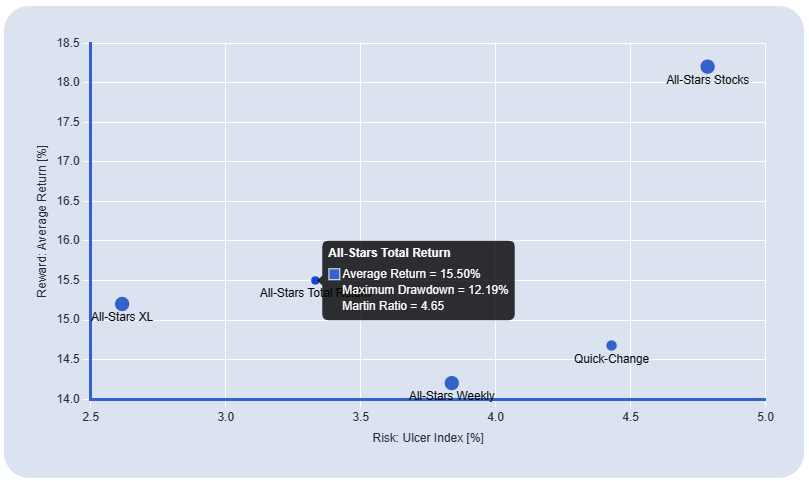
To use the chart, pick your acceptable level of risk, for example, an Ulcer Index of 3%. All portfolios matching this profile are on the left of this line. Among this group of portfolios, those with the highest returns are likely to be good choices, provided their other characteristics, e.g., investment style and rebalancing frequency, align with your requirements.
But the key to making informed investment decisions is understanding the charts & metrics. Therefore, we highly recommend you read the information we provide for each portfolio.
Learn more about: